






 30 DAYS OPEN PURCHASE
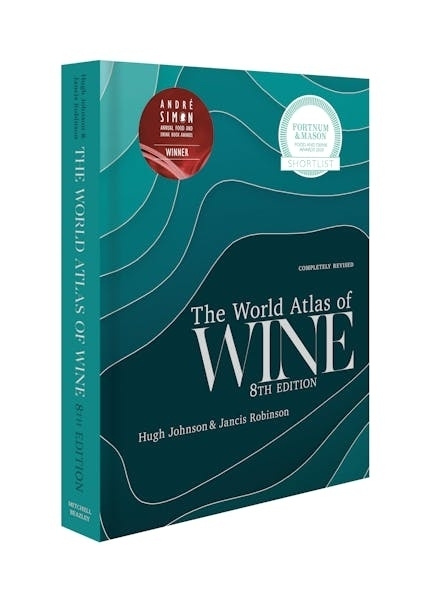
The World Atlas of Wine is the most widely used reference work on wine and the only one that begins with the map rather than the bottle.
Hugh Johnson published the first edition in 1971 and did something no one had done before, mapping the world’s wine regions with the same precision as a proper atlas. From the fifth edition onwards he has written it together with Jancis Robinson, the first person from outside the wine trade to become a Master of Wine and since then one of its most influential writers. In total, the book has sold 4.7 million copies and been translated into numerous languages.
What makes it irreplaceable is the maps. More than 200 of them, drawn so that vineyard boundaries, elevation, aspect, waterways and soil can be understood at the same time. It makes terroir comprehensible in a way that no amount of prose can. Once you have seen why one side of a slope in Burgundy is grand cru and the other is not, the concept hardly needs explaining again.
The eighth edition from 2019 was comprehensively revised and incorporates the changes brought about by climate. Regions that were barely covered in earlier editions have been given proper space, including England, Scandinavia, Japan, China and Uruguay, while the classic regions have been reworked according to current appellation boundaries.
This is not a tasting guide and contains no ratings of individual vintages. It is a geography book about wine, and for that reason it does not become outdated in the same way guides do. For anyone who wants to understand why wine tastes the way it does rather than which wine happens to be best this year, there is no substitute.
Number of pages: 416
Number of maps: More than 200
Edition: Eighth edition
Publisher: Mitchell Beazley
ISBN: 9781784724030
Language: English
First published: 1971, This eighth edition: 2019