







 30 DAYS OPEN PURCHASE

Heston Blumenthal is self-taught. As a young man he read Harold McGee's On Food and Cooking and from there began questioning why kitchens do things the way they do, with no mentor to whom he owed any loyalty. In 1995 he opened The Fat Duck in a sixteenth-century building in the village of Bray outside London. Nine years later the restaurant had three Michelin stars, and in 2005 it was named the best restaurant in the world.
The food there was a story rather than a meal. The menu was built around memory and sensory perception, the aperitif was frozen tableside in liquid nitrogen, and one of its most talked-about dishes was bacon-and-egg ice cream. It sounds like provocation, but it was not. Every element had been tested for years.
The most widely adopted thing he created is also the simplest. Triple-cooked chips are his invention, developed by testing each stage separately, and today they appear on menus all over the world without anyone remembering where they came from. If you have eaten genuinely good chips in a restaurant over the past decade, you have eaten his work.
The book is unusually constructed. Roughly half the volume is the story of how the restaurant came into being, written by Blumenthal himself and including everything that went wrong along the way. Then come the recipes, and they are restaurant recipes in the most uncompromising sense of the term. The snail porridge is in there. Nobody expects you to cook them. Finally, there is a scientific section written with physicist Peter Barham.
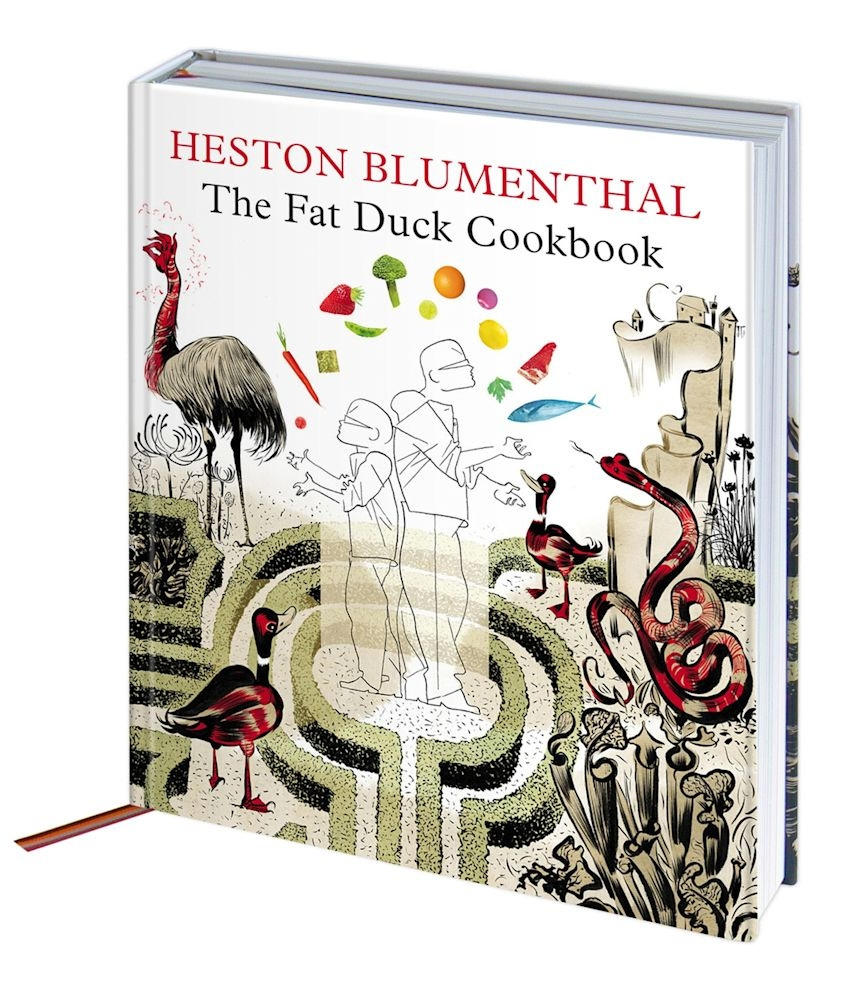
The graphic design and illustrations are by Dave McKean, best known for his covers for Sandman, making the book as much a work of visual art as a culinary one. It is a showpiece in the original sense of the word and belongs on display, not hidden away in a cupboard.
Format: Hardback
Number of pages: 532
Language: English
First published: 2008
The Kitchen Lab Selection
France was the obvious centre of gastronomy for 150 years. Two people broke that order at roughly the same time, and they did it from opposite directions. Adrià worked from creativity and deconstruction at elBulli. Blumenthal worked at The Fat Duck from science and from questioning why things are done the way they are, and because he is self-taught he had no tradition to be loyal to.
The space those two opened was the precondition for Noma. Without that shift, locality could never have become an organising principle, because the authority would still have rested in France.
Blumenthal's own contribution is the work on the senses. Sound of the Sea was served with a recording of waves, not as an effect but because hearing genuinely affects how food tastes, investigated together with psychologists at Oxford. Nobody else has done that work.
The book is moreover as much an object as a book, and it is worth owning for both.