







 30 DAYS OPEN PURCHASE
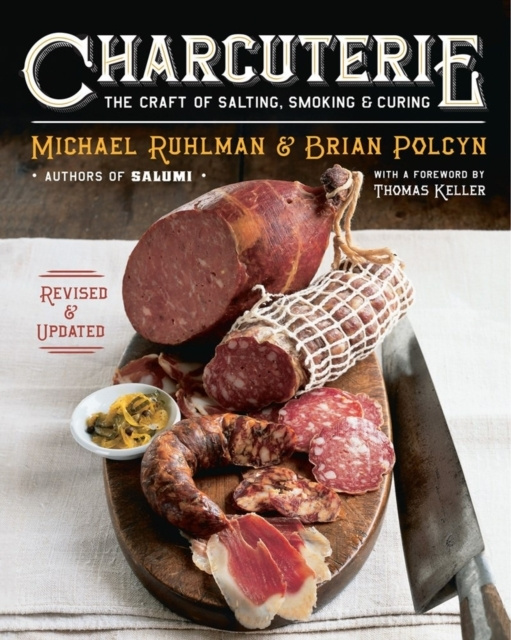
Charcuterie is the book that transformed charcuterie from a professional secret into something people make at home, and it did so by being precise exactly where precision actually matters.
Michael Ruhlman is an author who has written, among other things, about his time at the Culinary Institute of America. Brian Polcyn is a chef and teaches charcuterie. The combination means the book explains both why and exactly how much.
The latter is the point. Salt is specified as a percentage of the weight of the meat rather than by volume, because the difference between 2.5 and 3 per cent determines whether the product turns out good or unpleasant. Nitrite curing salt is non-negotiable when dry-curing, for reasons involving botulism rather than tradition. When drying, doneness is measured by weight loss, meaning when the charcuterie has lost between 30 and 40 per cent of its original weight, not by the number of days. Sausage requires the correct proportion of fat and everything must be kept ice-cold throughout the entire process, otherwise the emulsion breaks and the result becomes grainy.
The contents cover salting and brining, sausage-making in all its forms, terrines, pâtés, rillettes, confit, dry-curing and smoking. The revised edition also broadens the concept to include anything preserved or prepared in advance, including pickles, sauerkraut and vegetable rillettes.
125 recipes, and the only book in English where the proportions are written out in a way you can trust.
Format: Hardback
Number of recipes: 125
Publisher: W. W. Norton
ISBN: 9780393240054
Language: English
First published: 2005, this revised edition: 2013