

 30 DAYS OPEN PURCHASE
Something subtle but decisive happens when an ordinary knife meets a piece of lamb that has rested at 57 degrees for eight hours: the blade presses. Not much, but enough to put pressure on the muscle fibres that have swollen with liquid during cooking, and at that moment some of that juice decides to take an alternative route out. It's not always visible, but it's noticeable in the mouth. An ultrasonic knife works in a fundamentally different way. The blade vibrates with up to 60,000 movements per second in an amplitude range so small it's immeasurable to the naked eye, and the effect is that it separates the meat fibres rather than pressing through them. The result is a cut without compression, without fibre damage and without fluid loss.
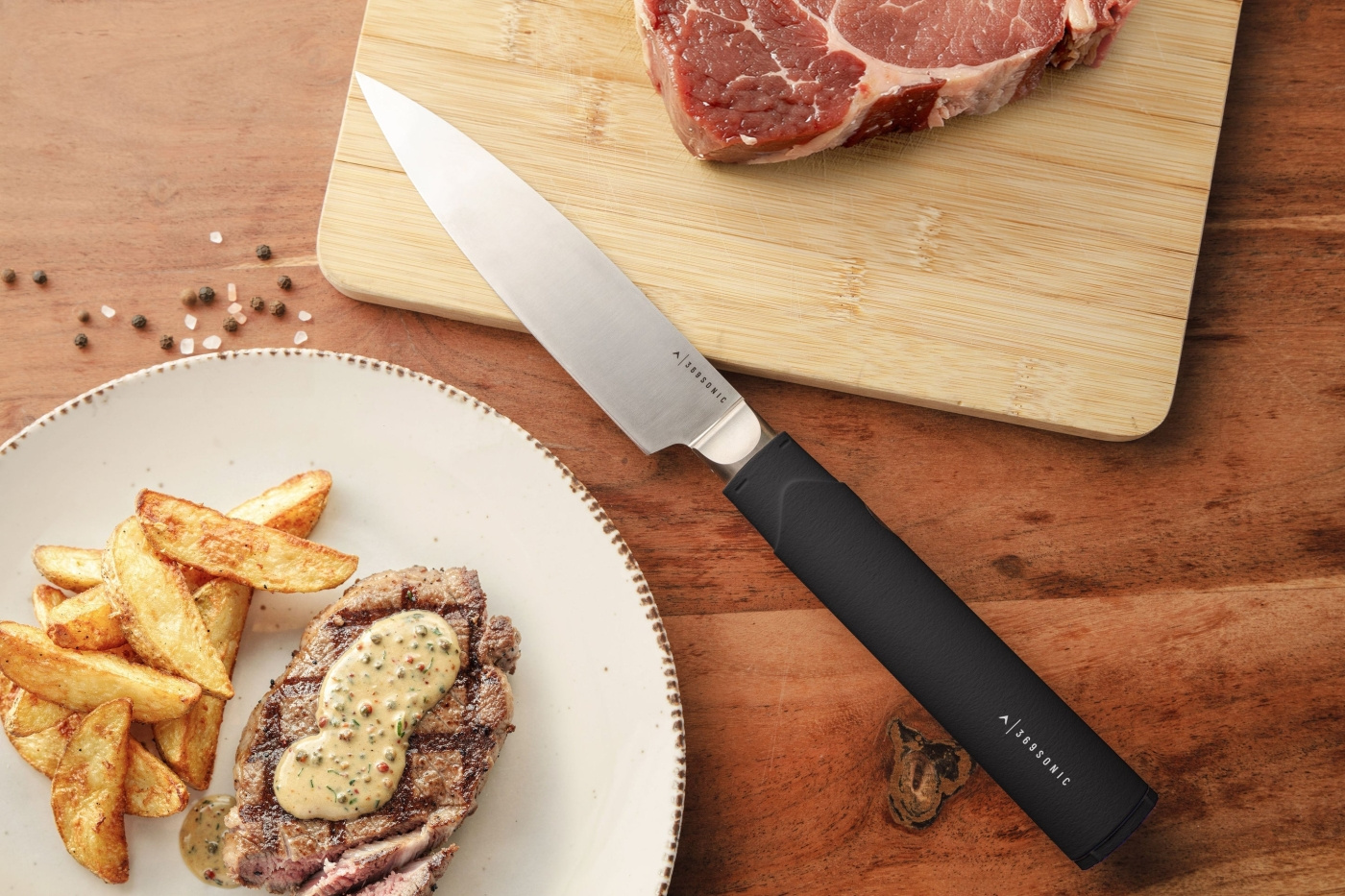
That's precisely what makes this a knife that finds its place in specific moments, not as a replacement for everything else. Sous vide-cooked meat is one of these moments. Chicken breast cooked at 62 degrees, roast beef or lamb racks that have reached exactly the core temperature you wanted, beef tenderloin that has never seen an oven temperature higher than 54 degrees. All of this shares a common challenge: the tissue is soft, full of liquid and sensitive to mechanical influence. The ultrasonic blade passes through without disturbing the structure, and the cuts you get are even, intact and representative of the cooking you invested time in.
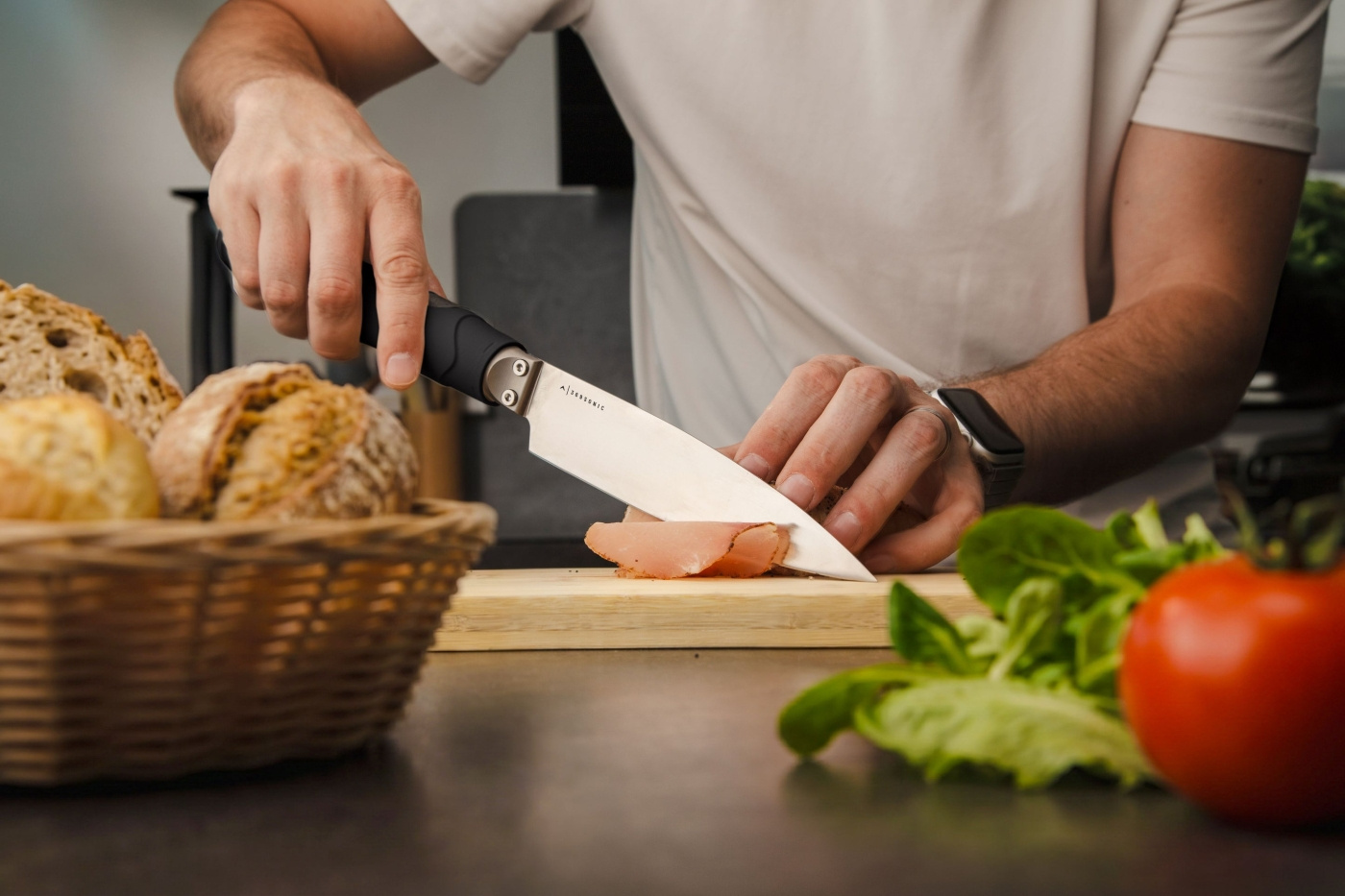
In charcuterie the effect is different but equally clear. The problem with slicing salami, coppa, bresaola, air-dried ham or other charcuterie with a regular blade is rarely about sharpness. It's about the fat sticking, the blade dragging the surface slightly with each movement, the thinnest slices cracking or folding. With an ultrasonic knife the blade stops being a sticking magnet. The fat, which softens with body heat and friction, doesn't have time to stick before the blade has already passed. You can slice bresaola to 1.5 mm without it tearing. You can slice lardo to the thickness of a business card. You can slice a whole salami Milano with identical slices without spending half an hour wiping the blade again and again.
Cheeses belong to the ingredients that conventional knives handle with mixed success. Hard cheeses like aged Swedish cheddar or parmesan present no problems for a sharp blade. But soft cheeses like brie, camembert or a well-ripened taleggio stick to the blade and are deformed in the cuts. Semi-hard cheeses with a tough consistency require persistent work and give uneven results. Blue cheeses like stilton or gorgonzola crumble if the pressure is wrong. An ultrasonic knife handles all of these without issue, because it reduces the friction pressure against the cheese to a point where the material is not deformed. That applies to cheesecakes too: a dense, gelatinous layer on top of a jelly layer on top of a biscuit base. Every cut with a regular blade smears the top layer into the bottom and crushes the base. With the ultrasonic knife the blade glides through each layer without them mixing, and you lift up a slice that looks exactly like the cake it came from.
Cheesecake is actually an excellent test for any ultrasonic knife, because it gathers precisely the properties that make the technology relevant: chilled filling with a high fat content, layers with different consistency and density, a decorative surface that shouldn't be disturbed. The result with an ultrasonic knife is a cut with a mirror-smooth surface, without drag marks, without sticking, without the top collapsing into the filling. If you want to serve sixteen perfect slices from a large, round cheesecake at a dessert table, with exactly the same appearance on all of them, it's a reasonable choice to make this one of the tools.
It's also worth talking about when it isn't used. Chopping onions, shredding cabbage, quartering potatoes, hacking through a whole chicken, crushing garlic with the flat side of the blade. None of that. Absolutely not for slicing cucumber or mushroom as in all the example images either, that's easy with a regular sharp knife. The vibrations add nothing in those contexts, and the knife is too delicate for coarse tasks. It doesn't have the stiffness required to work against a bone or divide a frozen ingredient in half. It's a specialised precision tool, in the same way as a mandoline, a blowtorch or a sous-vide circulator, and it is what it is because it's constructed to do one specific thing exceptionally well.
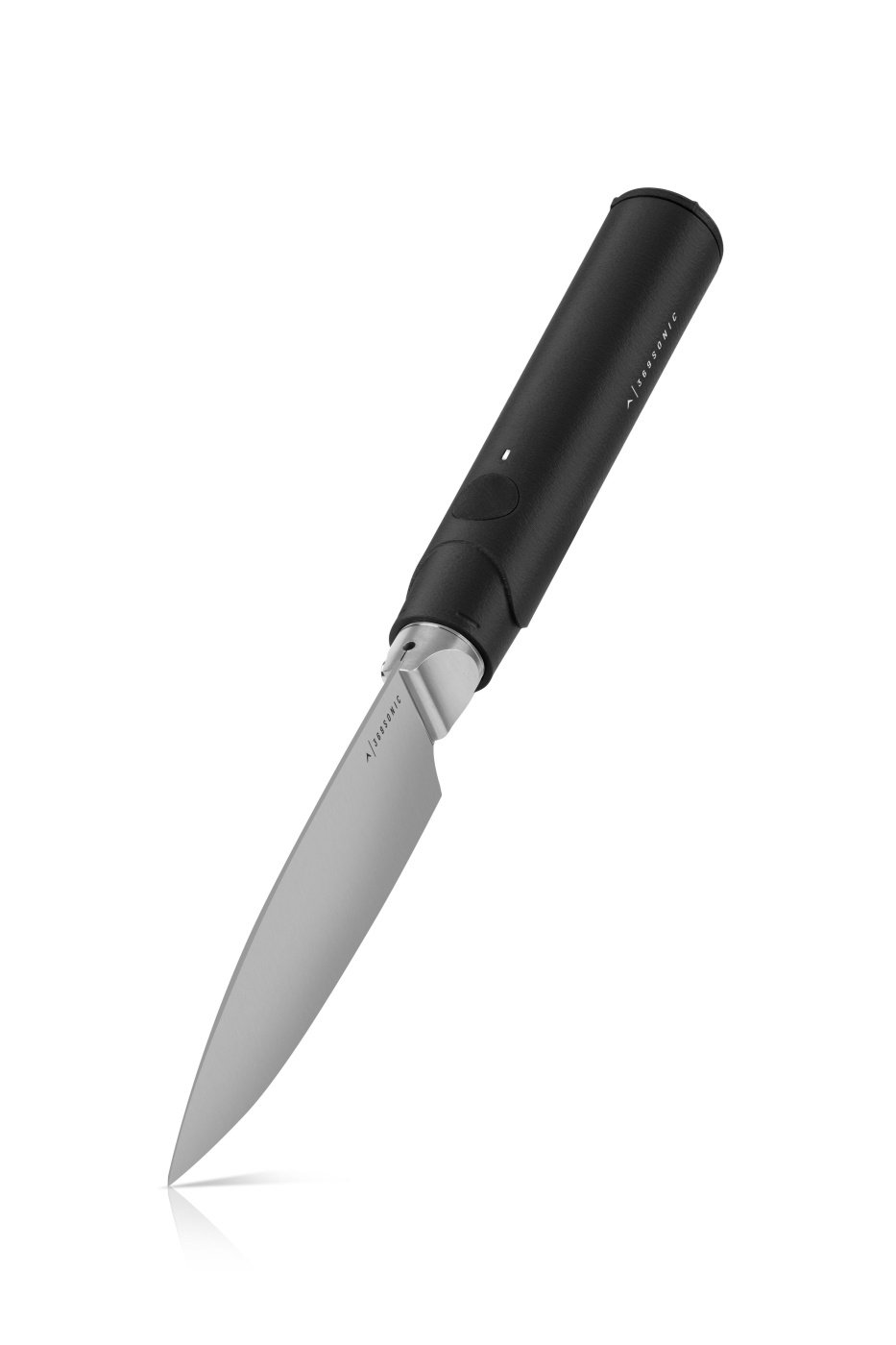
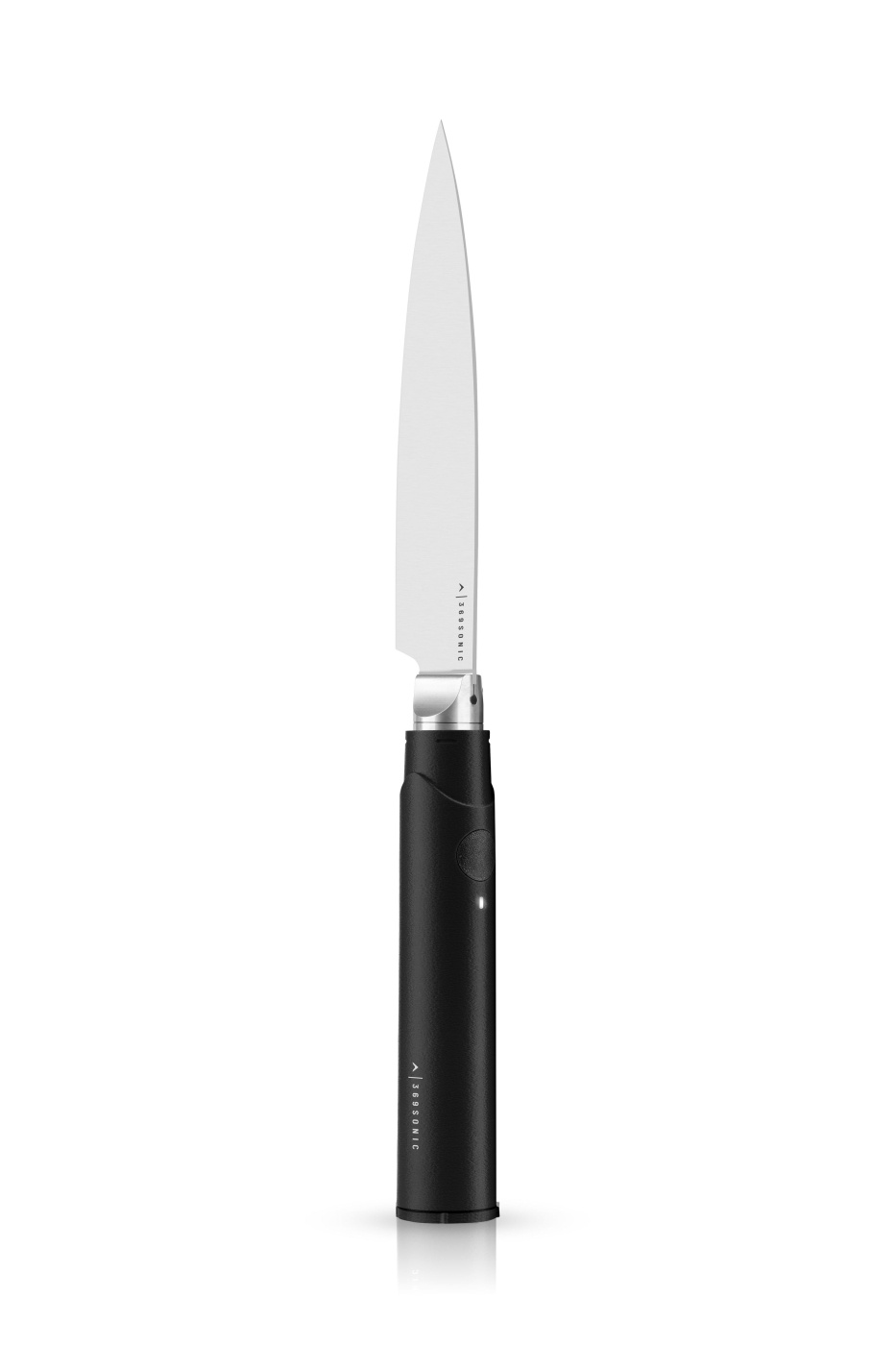
New Generation is 369Sonic's wireless generation. Charges via USB-C (9V) with a replaceable snap-in battery. Titanium transducer. Bluetooth connection for frequency monitoring via app. Power: 70W. Frequency range: 25-60 kHz, dynamically controlled by the processor depending on resistance in the material. Weight: 270 g. Made in Europe.