








 30 DAYS OPEN PURCHASE
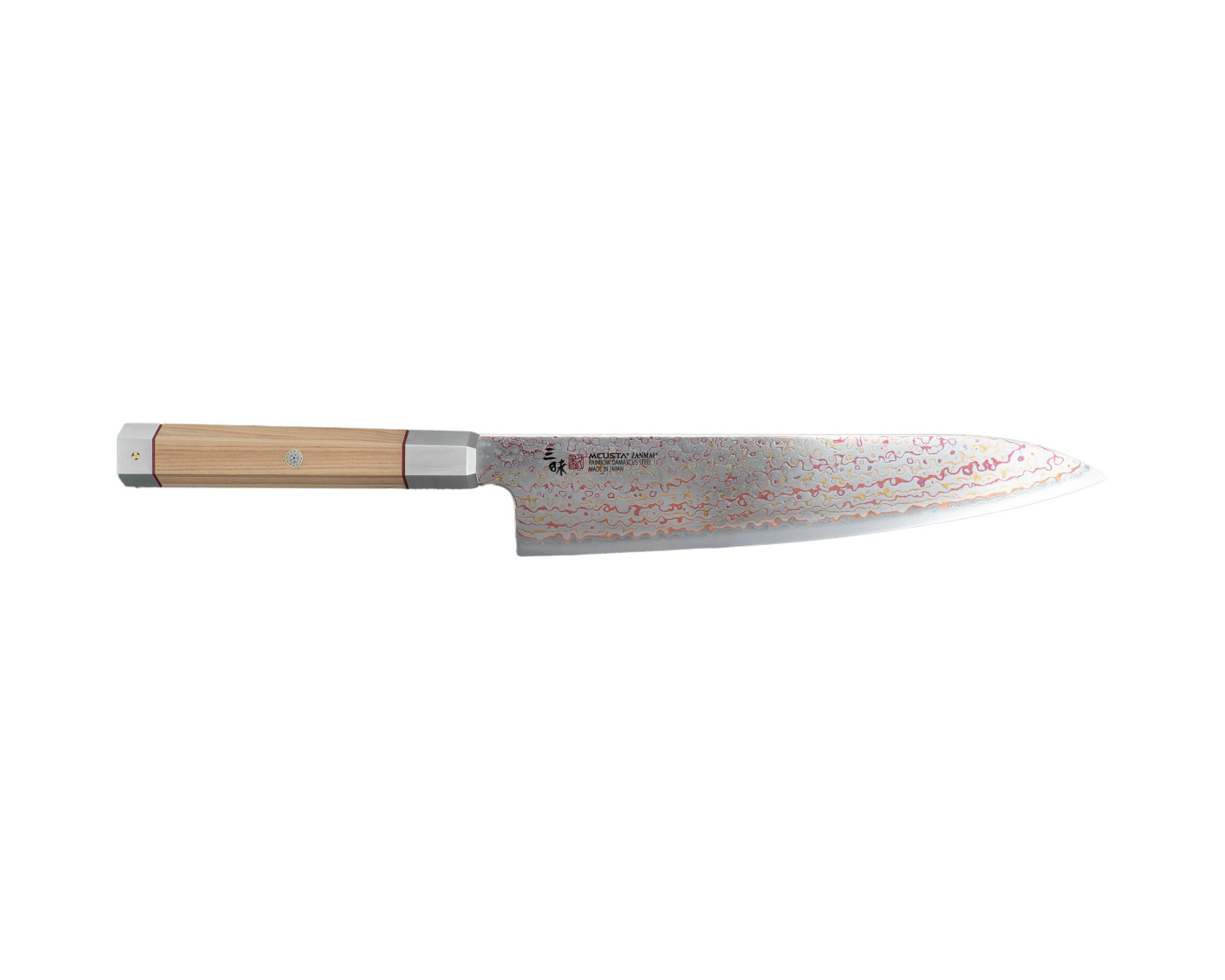
Seki in Gifu Prefecture has been producing blades for more than 800 years. In the past, swords were laid into heat-treated charcoal beds along the rivers. Today, kitchen knives have taken their place, and the craftsmanship once devoted to arming samurai is now used to slice salmon and root vegetables. Mcusta Zanmai is Seki's most ambitious modern knife maker, and the Ultimate III White Phoenix 2025 represents the pinnacle of what they are capable of producing.
The core steel is V-Toku2, an alloyed carbon steel from Takefu Special Steel smelted from Swedish iron ore. It is not stainless but contains carbon (1.05%), tungsten (1.25%), vanadium (0.20%) and manganese in a composition that produces exceptionally hard carbides and edge retention that most modern stainless steels simply cannot match. Zanmai heat-treats it to a hardness of 64 HRC, a figure that deserves some explanation: German kitchen knives are typically hardened to between 56 and 58 HRC. Japanese premium steels generally begin around 62 HRC. At 64 HRC, you are looking at a steel that keeps its edge long after others have returned to the whetstone and one that allows for a thinner, keener bevel without sacrificing stability.
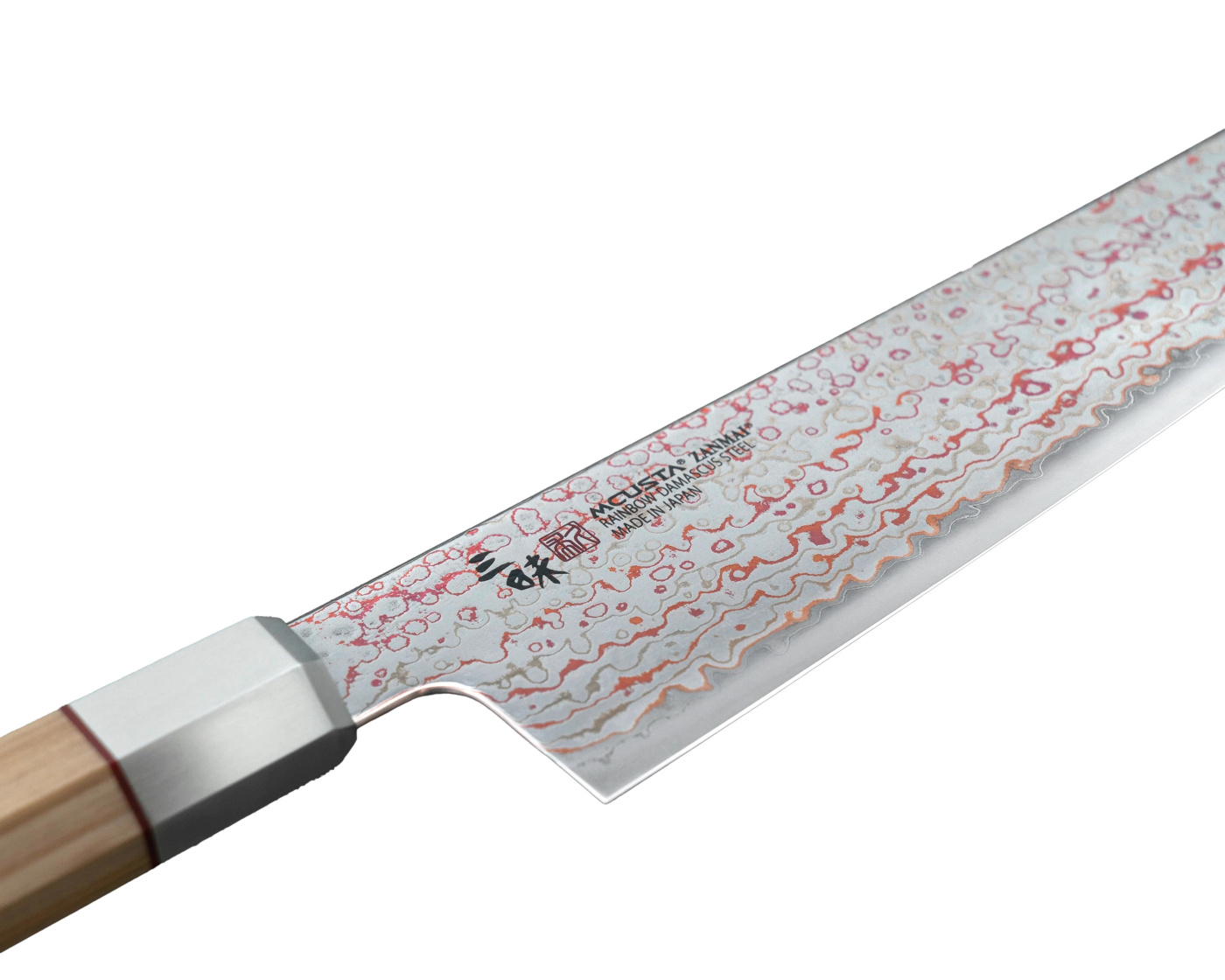
The construction is San Mai, meaning three layers. The V-Toku2 core is clad on both sides with stainless steel, making the blade more resistant to cracking and chipping than if it were made from monosteel alone. This allows the core to be hardened beyond what would otherwise be practical without making the knife fragile, even in the hands of a professional chef working under pressure.
What makes the White Phoenix truly the White Phoenix is the finish applied to the stainless outer cladding. Zanmai acid-etches and colour-treats the surface in a process that is labour-intensive, difficult to control with precision and impossible to reproduce identically. The result is a flowing wave pattern in shades of red, orange and gold running along the entire blade. Every knife looks slightly different. It is not a promise of perfection but a promise that no one else owns exactly the same knife. It is called White Phoenix for a reason: viewed along the blade in the right light, the pattern seems to move like a bird in flight.
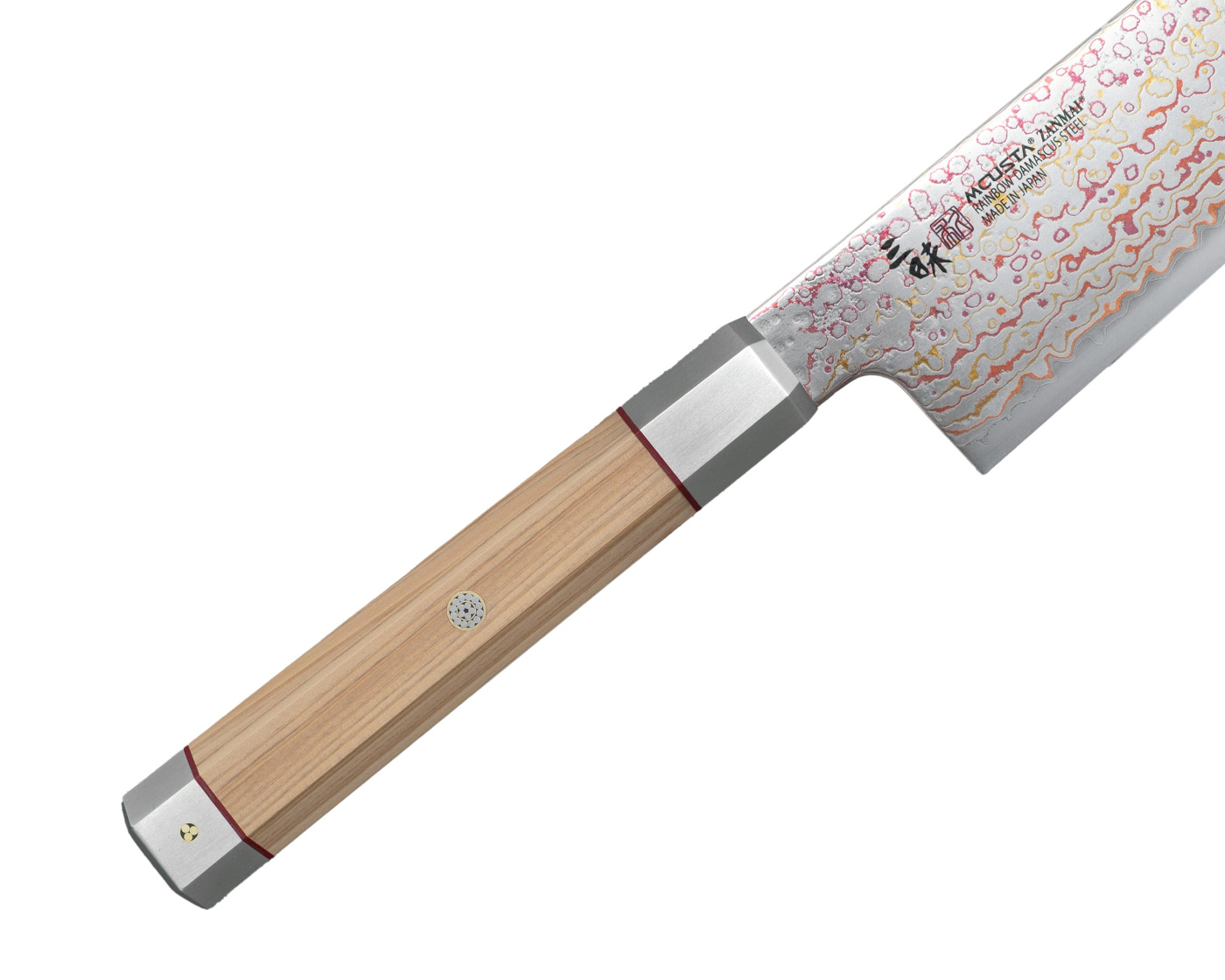
The handle is made from hinoki, Japanese cypress. It is the same wood traditionally used to build Japanese bathhouses. It has a warm, resinous scent and naturally antimicrobial properties. In the hand it feels light and dry, while the octagonal cross-section naturally guides the grip and allows the knife to be rotated with precision and ease. The fittings are made from nickel silver, a copper alloy containing nickel and zinc that provides a bright silver finish while offering greater hardness and corrosion resistance than brass. The mosaic pins are the kind of detail you notice only when looking closely, then stop noticing altogether because they simply feel right.
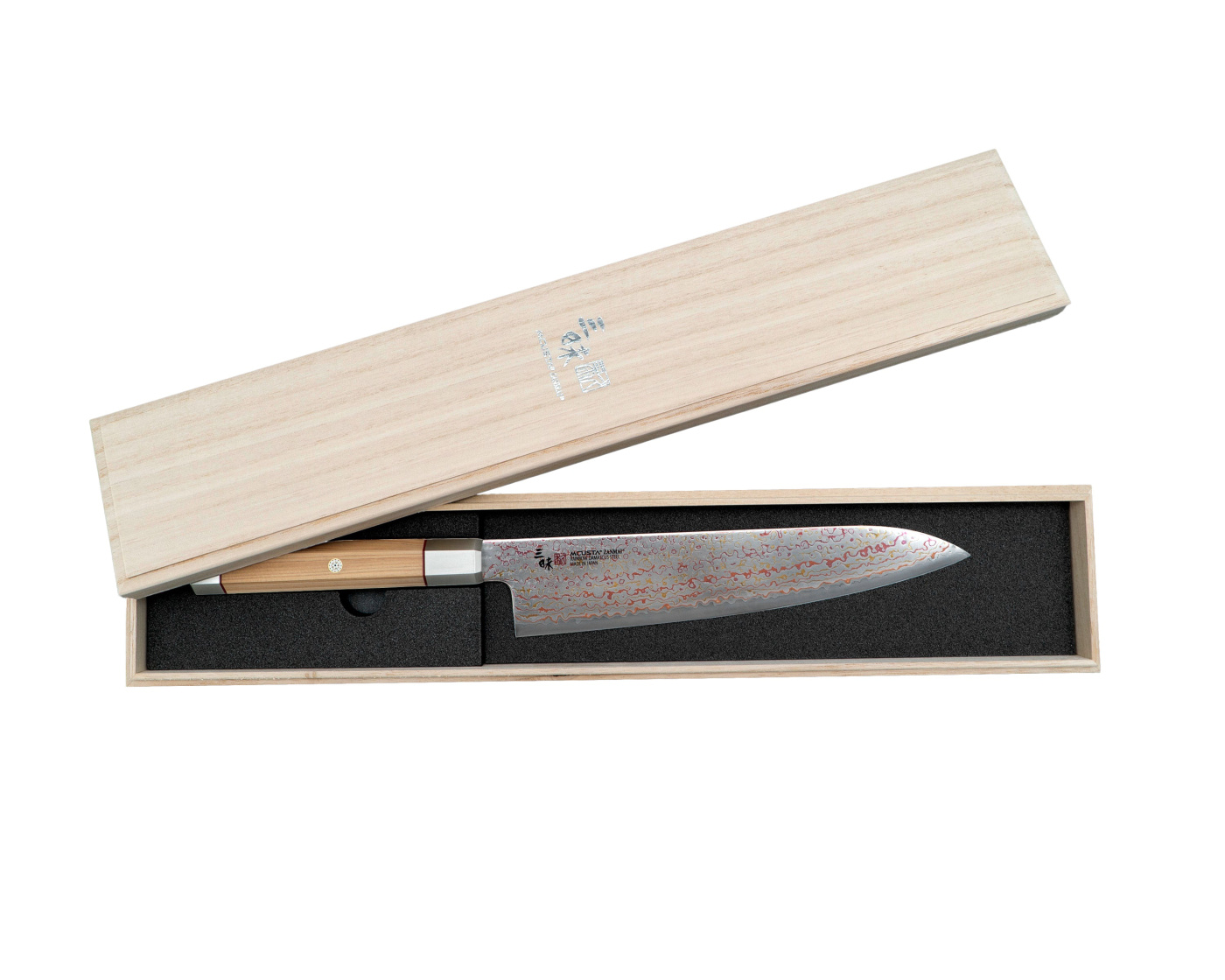
The knife is supplied in a paulownia wood presentation box, known in Japanese as a kiri-bako. Paulownia is one of the lightest hardwoods in the world, with exceptionally low moisture absorption, and has historically been used in Japan to store valuable possessions. Shipping the knife in such a box says as much about what Zanmai thinks of this knife as any specification ever could.
In the kitchen, 64 HRC translates into effortless cuts through fish, meat and vegetables, with a blade geometry that works with gravity rather than against it. Most people who pick up the White Phoenix for the first time notice its balance before anything else: 198 grams distributed so that the knife naturally tips ever so slightly towards the blade, and how remarkably thin the blade feels without ever seeming delicate. It is not a tool designed to do everything. It is a tool designed to do one thing better than most other knives ever will.
V-Toku2 is not stainless and requires proper care. Wash by hand, dry immediately and store in a dry place. Over time, the steel develops a patina — a darker surface that forms naturally through contact with food and provides a degree of protection against further oxidation. It is not a flaw but the hallmark of a high-carbon steel that is meant to be lived with rather than maintained from a distance. Sharpen it on whetstones, never in an electric sharpener. At 64 HRC, sharpening is needed less frequently, but when the time comes, a Japanese waterstone of the appropriate grit is the correct tool.
Only five examples of this knife exist in Sweden. Not five remaining. Five in total. The ZANMAI Ultimate III White Phoenix is not distributed through European retailers.
Blade length: 210 mm. Blade height (at the heel): 45 mm. Spine thickness at the heel: 2.0 mm; midway: 1.8 mm. Overall length: 355 mm. Weight: 198 g. Handle length: 132 mm. Handle shape: octagonal (hachikaku). Hardness: 64 HRC. Construction: San Mai. Edge grind: double bevel 50/50. Manufactured by Marusho Industry in Seki, Gifu, Japan.